



International logistics in the automotive sector is one of the most demanding and strategic areas of global trade.
Moving components from suppliers spread across the world to assembly lines, and then distributing finished vehicles to markets across different continents, requires precise coordination, regulatory expertise, and the ability to respond to unforeseen events.
Because it involves highly complex processes, this Dux Logistics article details how this supply chain works, the main operational models, the most critical challenges, and the trends reshaping the industry.
Discover more details below.
How does international automotive logistics work?
International automotive logistics operates through multiple simultaneous flows, from parts supply to final vehicle delivery to the customer. Throughout this process, it involves different transportation modes, customs regimes, certification processes, and compliance requirements in each country of origin and destination.
At the center of this structure are OEMs (Original Equipment Manufacturers), which coordinate a global network of suppliers, logistics providers, and distributors to ensure that every stage is completed on time and in compliance with legal requirements.
For the system to function, various regulatory bodies and agencies in each country must be involved, including:
- Customs authorities (such as Receita Federal): responsible for customs clearance procedures and import taxation of vehicles and components;
- Environmental agencies (such as IBAMA in Brazil): responsible for ensuring compliance with emissions and environmental standards;
- Traffic authorities (Detran / Denatran): responsible for vehicle approval for road circulation and issuance of certificates such as CAT;
- Health agencies (such as ANVISA): required when vehicles carry medical, dental, or sanitary equipment;
- Foreign trade ministries and agencies: responsible for import licenses and trade restrictions based on national policies.
In addition to regulatory requirements, selecting the transportation mode is a critical factor: sea, air, or road transport each involves different timelines, costs, and risk levels depending on cargo type, volume, and urgency.
Finally, every operation requires specific documentation, such as Import Licenses (LI), Import Declarations (DI), environmental and traffic compliance certificates, as well as fiscal documents issued in the country of origin.
Main taxes and costs in automotive logistics
In automotive imports, vehicles and components are subject to multiple taxes that directly affect overall costs:
- Import Duty (II)
- Industrialized Products Tax (IPI)
- Goods and Services Circulation Tax (ICMS)
- Social Integration Program (PIS)
- Social Security Financing Contribution (COFINS)
In addition to taxes, imported vehicles must undergo inspection and homologation carried out by INMETRO before being authorized for circulation.
Main flows in the automotive logistics chain
The logistics operation can be divided into four main flows:
- Inbound flow: management and transport of auto parts and components from global suppliers to assembly plants;
- In-house logistics: internal movement of materials within the manufacturing facility;
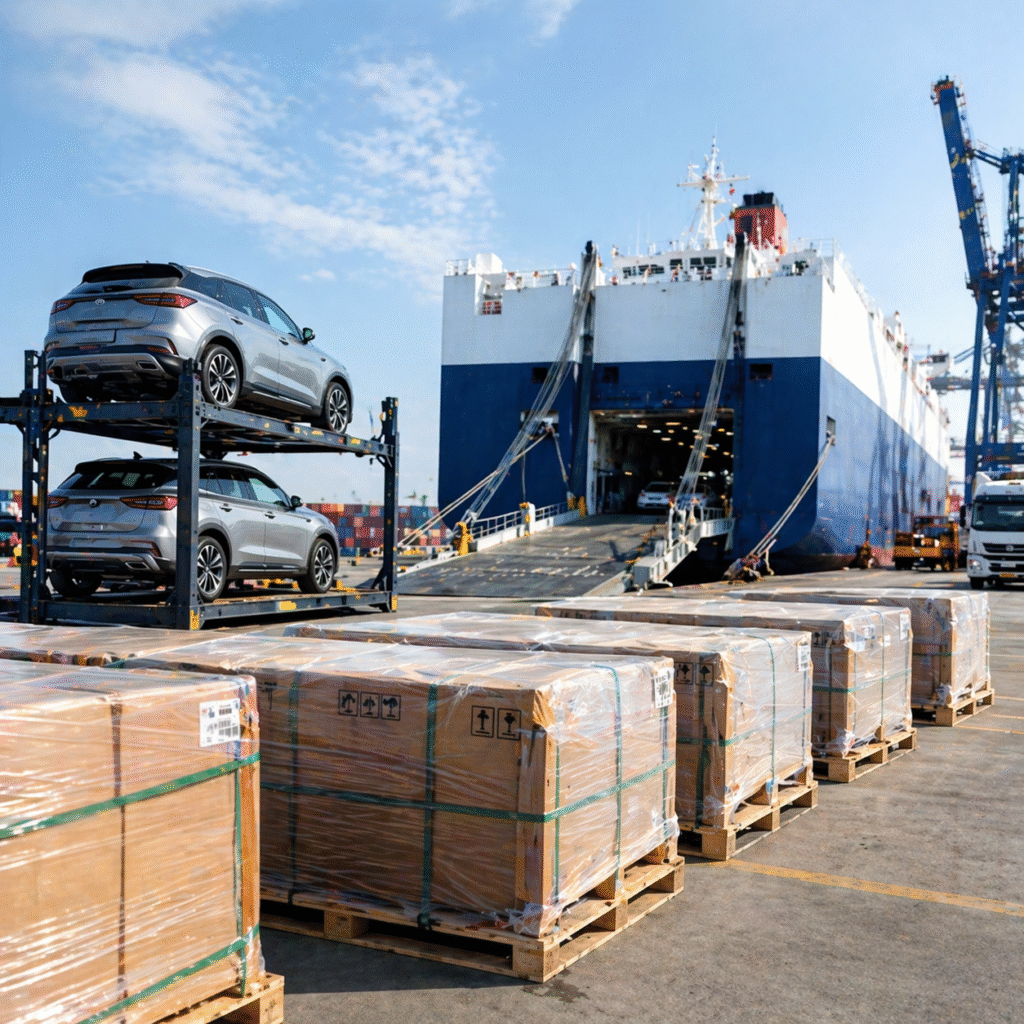
- Outbound flow: distribution of finished vehicles to dealerships and global markets;
- Reverse logistics: return of packaging, containers, and parts for reuse or proper disposal.
Production and export models in the automotive sector
The industry operates under three main production models:
- CBU (Completely Built Up): the vehicle is fully assembled in the country of origin and exported as a finished product;
- CKD (Completely Knocked Down): the vehicle is exported in fully disassembled kits for assembly in the destination country;
- SKD (Semi-Knocked Down): the vehicle is partially assembled, with final assembly completed in the destination market.
The choice depends on regulations, production volume, tax incentives, and local industrial capacity.
How automotive logistics operations work in practice
Before export:
- supplier mapping and qualification
- import license (LI) approval
- environmental and compliance certifications
- transportation mode and route selection
- cargo consolidation and shipping documentation
After arrival in the destination country:
- import declaration (DI) filing
- customs inspection and clearance
- homologation process (when applicable)
- distribution to dealerships, storage facilities, or end customers
Key challenges in international automotive logistics
The main challenges include:
- Just-in-Time (JIT) and Just-in-Sequence (JIS) production pressure
- supply chain vulnerability and disruptions
- high SKU complexity across global operations
- geopolitical risks, strikes, and logistics bottlenecks
Leading countries in global automotive trade
The leading exporters include Germany, Japan, the United States, South Korea, and Mexico. Major importers include the United States, Germany, and China. Brazil holds a mid-level position in imports and shows strong export performance.
Advantages of using a specialized automotive logistics company
- reduced logistics costs
- higher operational safety and compliance
- regulatory and documentation expertise
- optimized lead times and processes
- access to a global logistics network
- focus on core business activities
Conclusion
International automotive logistics is one of the most complex and strategic supply chains in global trade.
From component sourcing to finished vehicle distribution, every step requires planning, regulatory compliance, and trusted logistics partners.
With the right expertise and support, this complexity becomes a competitive advantage.
Automotive international logistics with Dux Logistics
At Dux Logistics, service only ends when the product reaches the final customer. We oversee every stage of the supply chain to ensure no delays or losses occur during operations.
We manage international transport, documentation compliance, storage, and distribution through integrated and customized solutions.
Dux operates offices and warehouses in Brazil, the United States, and France, providing global logistics coverage tailored to each operation.
Need a customized strategy? Our specialists are ready to support you.